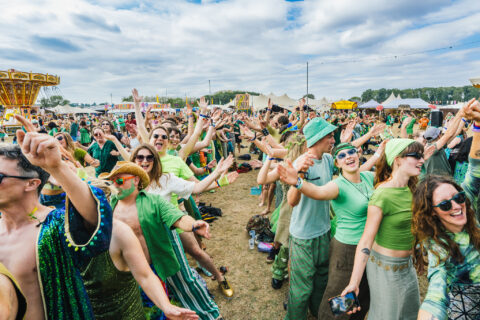

In a nutshell, we believe we should take care of each other and the planet we inhabit. We have been green for donkey's years, and have always had a host of initiatives to minimise Shambala's carbon footprint. We have represented environmental, and social justice issues at the event, but have deliberately sought not politicise Shambala. We have aimed Shambala to be a break from normal life, where cooperation and a rich tapestry of creative experiences inspire us to take an extra bit of positivity back into society. We are not yoghurt weavers, more pragmatists, but there is certainly some magic involved in Shambala that has evolved of its own accord. We have been careful to make sure the festival is considered in its approach, and relationships have been based on trust and fairness.
We believe that man-made climate change is happening. We also believe it is of great importance to protect the lands we live in, the air we breathe, the water we drink, and species from extinction. The world is a beautiful, powerful, and diverse wonderland, and we want to celebrate it, and not trash it.
If you have any questions specifically relating to green issues at Shambala, you can contact our sustainability coordinator though the contact page. Plenty info below to start with...
We are proud to have been named the 'most sustainable event in the UK (2008)' by NOEA, and been judged one of the 3 most sustainable events in the UK by 'The Greener Awards'. Here's a brief list of our 'green' credentials, including new initiatives for 2010. If you'd like to read more detailed info about our environmental strategies and operation, you can download the documents below, which include carbon audits, our environmental policy, green action plan and other bits and bobs as we complete them.
The Approach
We are working on the basis that climate change is real, that carbon is a major contributor, and that we should reduce and mitigate carbon use.
Shambala's Carbon Footprint
Since 2006 we have been doing detailed carbon audits of the event to measure our 'footprint', and record how effectively we are reducing it each year, and in what areas we are making reductions. In 2008 we took the bold move to use 95% non-mineral based power on-site. This, along with comprehensive composting reduced our 'operational' footprint by almost half - i.e. the footprint of running the event itself. Unfortunately for you guys (our festival-goers), this pushed the relative %age of your travel to and from the event from 66% to 78% of the total footprint. In 2009 we abandoned renewable power for cost and practical reasons, in order to take stock and find a better approach. In 2010 we are back with 100% renewable power - let's see how it goes! Whilst there are still some improvements we can and will make to the event itself, the only logical focus is to tackle the 369 tonnes of carbon your travel produces! The questions is, how best to do this?
Why off-setting?
Offsetting has had bad press. It's not a solution, or a way to avoid across-the-board change. But if we are to find a way to reduce carbon emissions on a world scale, we need to place a value on them. While it's free to pollute, people will do so freely. So we believe in responsible off-setting, as a final measure, after other methods have been used to their full potential to reduce emissions. We encourage and support sustainable transport options, but many people still require their own vehicles - families, crew, people who live in their trucks, contractors with equipment etc. The show must go on! So to account for this, we use a proven, accredited offsetting scheme to put back what we are taking away, or take away what we have left - depending how you see the equation!
How did we work out the costs?
We teamed up with the Centre for Alternative Technology to establish what is good practice, and what it really costs. We found the market rate for offsetting (£10/ton) was too low to fund effective programs, and a lot of firms have dubious practice. You are paying the equivalent of £100/ton, which works out at circa only £1.80 per 100miles!
Where does the offset Money go?
In 2009 we offered several well-researched projects on the web, and put them to a vote for contributors to choose which scheme to support. The winner for 2009, as voted by you, was the World Land Trust.
These are our priorities when we choose offsetting schemes:
Replace ‘removing capacity', i.e. plant trees [with positive side effect of providing habitats and maintaining local wildlife/diversity]
Educating young People on environmental issues - they are our future.
Investment in renewable power to replace reliance/use of carbon sources
Protect existing carbon removing capacity - such as solar cookers in Africa, reducing deforestation, with side effect of maintaining environments, local water systems, quality of land, and poverty reduction.
How you travel to the event (2008)
77.5% by car or van*
14% by train
7% on the Shambala Express (Coaches)
1.5% by bus.
We aim to increase the non-car travel to the event. In 2009 close to 100 people in total cycled to Shambala! In 2010 we are confident that we can increase this, and are planning to include rides from more cities.