Here we are again! Another year older, another year wiser, sillier and greener. And we’ve done our annual thing of reviewing our impact, from the big wins to the nuts and bolts.
A huge thank you to every single person (audience, crew, artists, suppliers and the rest) who contributed to this years’ adventure in utopia!
THIS YEAR’S HIGHLIGHTS
- £103,143.91 raised for community & environmental projects in 2025!
- One quarter of our audience arrived on coaches and trains reducing car emissions.
- Our food traders continued their climate-conscious cuisine with only 0.45kg CO2 – vs the UK average of 2kg – per plate!
- We pulled off a UK festival-first, supplying biogas across the site for showers and cooking (instead of LPG)!
- Every contractor who brought structures (tents) travelled less than 100 miles (average 93).
![Shambala_GeorgeHarrison_Shambolympics-2 [Web]](https://www.shambalafestival.org/wp-content/uploads/Shambala_GeorgeHarrison_Shambolympics-2-Web-300x200.jpeg)
SUSTAINABILITY
SHAMBALA’S CLIMATE-FRIENDLY CREDENTIALS
It’s been a journey to make our party the most purposeful and planet honouring possible. We learned a lot in the early days, making bold changes, and we’re proud to have been a leader in the festival scene towards more sustainable festivities for over 25 years.
1999

2001

2002

2004

2007

2008

2009

2010
2011

2012

2013

2014

2014

2015

2016

2017

2017
2018

2019

2020 (no festival!)

2021 (Shambino)
2022
2023

2023

2025


Carbon Footprint
We will always be upfront: Our carbon footprint has crept up this year. Not exactly what we were hoping for – but here’s the lowdown:
- We released slightly more public car parking passes, leading to 20 tonnes more emissions, as our coach and train travel packages didn’t sell as strongly as expected.
- Last year, we accidentally calculated Crew and Artist travel at about 50% of its true impact – a classic mistake of not including the return journey. That’s now been corrected.
- We used more HVO fuel during our site build, despite having fewer stages and people on site. We are investigating this ahead of 2026…
- We brought nearly 4 tonnes more wood, which resulted in over 4 tonnes more CO2 – this will be re-used as set and decor in future.
- The amount (weight) of waste decreased slightly, however the CO2 emissions actually increased due to changes in how emissions are calculated!
We measure our statistics on a per-person, per-day basis, as it’s more comparable.
2024
2025
* CO2e* means the “carbon dioxide equivalent”. It’s a term for accumulating different greenhouse gases into a common unit, and compares the global warming potential of these gases by converting all associated emissions into the equivalent warming of carbon dioxide.

Carbon Footprint Per Person Per Day:
Below is the amount of CO2 equivalent for each person who attended the festival as audience members, crew, artists or suppliers.

Travel
Travel is always the biggest chunk of emissions for any event. On average it constitutes 80%+ of festival emissions. At Shambala it’s 65%, as we manage to get a good amount of our festivalgoers and crew on coaches and trains.
This year, the proportion of Shambalan’s travelling to the festival by public transport dropped from one third in 2024 to one quarter in 2025. Green Travel tickets didn’t sell as strongly as last year – so if you’re on the fence about your 2026 travel plans, may we urge you to hop on the good foot and do the eco thing and buy a Green Traveller ticket.
To break it all down,
- Audience cars generated 366 tonnes of CO2e – 26 tonnes more than last year.
- Crew vehicles generated 218 tonnes CO2e – 21 tonnes more than 2024.
- Artists travel accounted for 61 tonnes CO2e – only a 2 tonne increase
- Our suppliers brought 85 tonnes CO2 – a significant decrease of 28 tonnes compared to last year, thanks to working with more local contractors.
Last year we measured our Crew travel incorrectly, counting only one-way trips instead of return journeys. Whoops! We’ve corrected this now, which increases the reported footprint for 2024 and 2025.

Energy
Shambala is powered without any fossil fuels. We use renewable biofuels in our generators, and have analysed meticulous energy monitors and cable plans to make sure they are the most efficient they can be. We also use some small but powerful batteries charged from the mains, for low-fi activities around the site like powering the Recycling Exchanges. Plus, we have installed a grid connection onsite on a 100% renewable tariff from Good Energy. We’d love all our energy to come from the grid, but it’s just not possible on the site.
The next steps could be mobile hydrogen energy or enormous batteries charged from renewable grid power, when they are available.

Waste
We are pleased to have made an improvement in waste management this year! Hurrah and congratulations to all our amazing utopian Shambalans.
- We produced slightly less waste, dropping from 45 to 42 tonnes.
- We recycled slightly more, increasing from 20 to 25 tonnes. This means our overall recycling rate, including compost, rose from 42% to 46% – above Bristol’s city-wide rate, the Green Capital of the UK!
We produced 79 tonnes of waste in 2025.
Kg waste per person per day
So although we produced a few hundred kilograms less waste, we had a few more people – so our waste per person did increase slightly this year. But we used more wood and materials this year to build new sets and decor that will be re-used in future.
Reducing waste and packaging is a passion of ours. We have a fruit & vegetable wholesaler, and a zero-waste scoop store at Shambala! Feel free to bring your own lunchboxes and cutlery too, as this reduces waste, and some traders even offer a discount.

Materials
Throughout the planning and build of Shambala, we are meticulous in accounting for all build materials, down to the screws and nails that hold it together. This year, we had to buy a few tonnes of hardwood for construction – however we’ll store this on site and not have to buy so much next year.
Since 2023, the legendary waste warriors at Rubbish Ideas have been incredible partners who’ve helped us develop the most detailed analysis of all our materials, resources and impacts to better spot areas for improvement. We’ll be using their platform in future to measure materials and impacts.
Food
Our food footprint increased to 67 tonnes (53 last year). We apparently served 16,000 more meals, which was a bit of a head-scratcher as we had almost the exact same amount of Shambalans on site. We’re still trying to understand this.
We’ve worked hard on our food offering to be true to our main Principles, one of which is To discover and share ways of moving to a sustainable future…
The average for UK festival food as a contribution to overall impact is 34%. But at Shambala, largely due to being meat, fish and dairy free, only 6% of our total emissions is from our food.
We are mostly dairy free onsite, using only oat milk across hot drinks traders. Why oats? Because oats can be grown locally, right here in the UK, and don’t need huge amounts of land, water, resources, pesticides, and animal cruelty to produce. Find out why we have Gone Off Milk.
We logged all our Trader meals and crew catering on Klimato – a software for measuring CO2e of food.
Crew Catering
We’ve been inspired by the ‘agroecological’ approach to food production. It is a holistic approach to farming that creates sustainable, resilient food systems, mimicking natural ecosystems.
Our Crew Catering (Henry’s Beard) have worked hard to find ingredients grown nearby. This year, 75% of our crew food came from within 200 miles.

Meat, Fish and Dairy
Our food systems are responsible for one third of global greenhouse gas emissions. Over three quarters of agricultural land on earth is used to raise animals, which eat over one third of all the world’s crops. Farmed meat provides just 18% of the world’s calories.
So we’re proud to have removed meat from our menus in 2016, and saved thousands of tonnes of CO2 in doing so, whilst inspiring our audience, and the industry that it can be done. Dairy farming has a similar story, due to the resource-heavy nature of keeping cows, so we removed cow’s milk from our hot drinks back in 2019.
Each year, just 12 miles up the road, Wild & Furrow, our local family run oat milk farm sends us over 5,000 litres of oat milk in glass bottles (and large reusable drums for Traders) to help us avoid unnecessary waste.
One thing we’re discussing behind the scenes is the role of wild venison in addressing imbalances in our ecosystems. There’s been a staggering boom in wild deer species in Britain, alongside a lack of natural predators, which is devastating biodiversity across the UK. Watch this space!
What can you, our Shambala community, do?
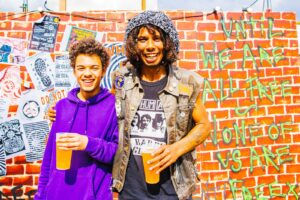
Battle disposable culture
When you’re on site with us, it would be BEYOND helpful, if you could:
- Avoid bringing too much plastic – wrapped snacks, bread and fruit which are often left behind and can contaminate general waste.
- Avoid disposable vapes – they get everywhere, they can’t be recycled and they’re super environmentally damaging.
- Check out our on-site, zero-waste van which offers delicious treats, or our on-site bakery or fruit & veg store which has all the fresh produce you’d want every day.
- Bring your own bits – bring a lunchbox and cutlery set, for your delicious meals from our amazing plant-based traders. There’s plenty of water on site to rinse and repeat!
![Louise Roberts-Shambala Festival 2023-294A6277 [Web]](https://www.shambalafestival.org/wp-content/uploads/Louise-Roberts-Shambala-Festival-2023-294A6277-Web-300x200.jpeg)
Waste
On site, contribute to the community and improve how we handle our waste:
- Grab a compost caddy from our Campsite Hubs to collect food waste – DON’T put food waste in the general waste bags.
- This way, we can turn your food waste into compost and put the energy back into the land.
- Separate recycling out carefully. Our audit showed there are still lots of mishaps happening, leading to less recycling!
- Collect up soft, flexible (scrunchable) plastics and return them to the supermarket. Show them we mean business on plastic-action!
- Aim to clean your recycling to avoid contamination. Empty your bottles of liquid properly, an give your yogurt of hummus pots a quick rinse..

Travel and transport
To help reduce one of the world’s largest sectors for emissions:
- Choose public transport – Our coach and rail options make this REALLY easy (plus they’re £40 cheaper than generally entry. Yes, we will literally bribe you to get the coach or train).
- Pack light, and prepare to squeeze into vehicles – The average amount of people per vehicle has dropped as people opt for smaller travel groups and more space. We’re currently at 2.8 people in each of the 4,000 cars on site. We’d love for 4 people per car which would mean a drop in hundreds of tonnes of travel CO2.
- Let us know if there’s anything holding you back, or any ideas you have to improve on travel emissions. The world of 2050 will have far less private transport, so we’ve all got to get our thinking hats on
![Ania Shrimpton_Shambala 2023-7127 [Web]](https://www.shambalafestival.org/wp-content/uploads/Ania-Shrimpton_Shambala-2023-7127-Web-300x200.jpeg)
Food
How you can help improve on food related emissions:
- Consider your cuisine: Our meals are already quite low impact, and we’re working on reducing the higher-impact ones by substituting dairy or far-flung items like rice where we can. Think local, and seasonable as you shop.
- Less meat and dairy: unequivocally, these animals require a lot of space, food, air, and everything else – vegetables are way less intensive.
- Normal life: Thinking like this at home help ripple the impacts of our food focus out into the world.
- Focus on: plant-based, local and seasonal produce to help reduce humans’ reliance on far-away, exotic ingredients and bring more low-carbon, community produce into our local areas.
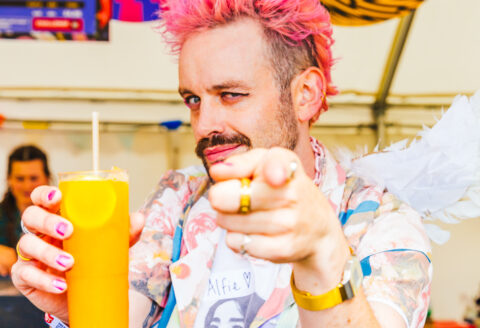
Drinks
How you can help improve our drink related impact:
- Please return the cups! They are made of plastic, and if they are not reused they are more carbon-intensive, and polluting that thin single use ones.
- We don’t brand them anymore to make them less appealing to be kept. They don’t belong to us and are used at heaps of other events.
- Drop them in CUP bins in the Arena or at the Cup Amnesty points on the way out… just please don’t take them away as they need to be returned.
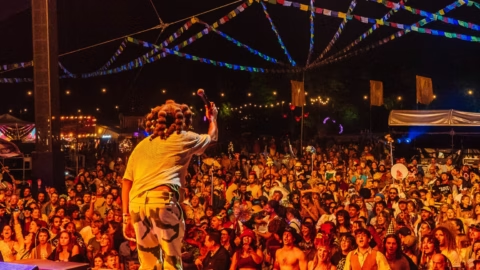
SOCIETY
We strongly believe festivals like Shambala should make a positive difference to society (as well as being a cracking party).
Festivals should be a place to strengthen community bonds, and provide transformative emotional benefits to improve lives. But it isn’t a party, unless it’s a party that welcomes everyone!

Gender representation on our stages
Since our origins, true representation in our teams and on our stages has been central to our raison d’être. In 2025, the ratio of artists/bands on our main stages with female and non-binary members averaged 61%. Bands with a female or non-binary front person were on average 44%.

Accessibility
Our accessibility applications have increased by 80% since 2022, due to the industry-leading measures we’ve taken. The following initiatives and services help support our disabled, neurodivergent and d/Deaf festival goers:
- Our dedicated Accessible Camping Area hosts nearly 500 people, with all buggies and equipment to make it a safe and comfortable stay on site.
- There are viewing platforms and areas on 14 stages with lowered bars across site, and queue jumps too, for those who need them.
- We have a British Sign Language interpreter service for those who need it.
- There are sensory spaces in the main arena and Playtopia for a quiet, calm pit stop when the need arises.
- We have a dedicated accessibility staff member on our team to support a consistent approach to supporting access at Shambala.

Community Impact
With your support and generosity, and through Shambala’s initiatives and charity partners, we raised another incredible amount which we donated to environmental and community causes through the festival this year.

The future…
Thanks to each and every one of you who has contributed to this incredibly wonderful and fluffy community of Shambalans that have made us one of the most sustainable festivals in the world!