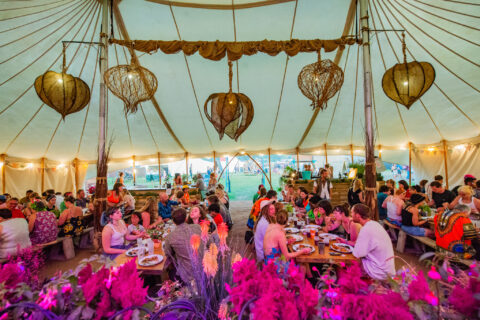
Now then. We’ve been batting a meaty question back and forth at HQ, and in Shambala style, we feel we should be consulting our wider community to make this decision.
Give this a read, chew it over, and then make your voices heard via the form below…
We know that the topic of food (especially meat) is an emotive one, and we welcome all ideas and feedback, and will honour the decision of our audience.
Since 2016, we’ve proudly served up a festival free from meat and fish. We did it to spark a conversation, and to show that what we eat has consequences far beyond our plates — on the climate, on ecosystems, and on communities around the globe. And it worked. The debate flourished, habits shifted, and many of us discovered that plant-powered feasts can be every bit as delicious and satisfying. And environmentally, it’s been a total winner – only 6% of our festival emissions now come from food, compared to 21% at the average UK music festival.
But – 10 years on – the world is not static, and neither do we intend to be. The ecological story unfolding in the UK demands our attention: deer numbers are at record highs, munching their way through meadows, woodlands and wetlands, stripping back biodiversity, stalling forest regeneration, and squeezing out countless native species. With no natural predators left in our landscapes, the balance is broken – and our ecosystems are suffering for it.
So here’s the twist: what if eating local wild venison is actually one of the most sustainable food choices we could make?
- Unlike industrial meat production, deer in the UK aren’t farmed, fed on imported soy, or transported across continents.
- They are wild, abundant, and most crucially, their overpopulation is a serious driver of biodiversity loss.
- The UK is described as one of the most nature-depleted countries on Earth based on long-term species trends (State of Nature Report 2023)
- Reducing their numbers helps nature recover.
- Eating venison closes the loop, turning a problem into nourishment, and restoring balance in the process.
Reintroducing meat at Shambala – but only in the form of wild UK venison – would be a deliberate provocation, an invitation to question our assumptions, and reinvigorate the whole conversation about what sustainable eating looks like, today, in the UK.
So, this year, alongside our glorious vegetarian and plant-based banquets, we are considering serving up one carefully considered meat option: wild British venison. A dish not of industrial destruction, but of ecological repair.
Should our community decide to give this a go, we’d be looking to introduce one wild venison trader at Shambala – serving only venison that has been culled as part of biodiversity protection efforts. A percentage of the trader’s profits would be donated to supporting biodiversity initiatives. We’d also look to have a talk and workshops on the topic of the UK’s deer issue, hosted on site, to dive deeper into this topic.
We know that around a third of our audience are vegetarian or vegan. We also know that for many of our community, the ethics of choosing a meat free lifestyle go far beyond environmental considerations. We appreciate the fact that every trader at Shambala is fully meat free may be of huge importance to you – and we don’t want to overlook or minimise this.
So, in true Shambala tradition, we want to put this decision in your hands… Fill in the form below to give us a yes or a no, and (if you wish) to expand upon your thoughts.
Voting will close on Friday 6th March at 11:59pm and we’ll share the results of this debate in more detail, shortly after.
Thanks team! x